Image

Spring 2026
2 units
Only one application needs to be completed for all courses desired during the quarter.
03/27/2026
This course will provide an overview of Artificial Intelligence (AI), with a particular emphasis on clinical applications and considerations. Topics covered will include use cases for AI in research and clinical care, AI design decisions, considerations for implementing AI tools in clinical practice, evaluation, interpretability, privacy, and fairness/bias.
Learner testimonials:
Thanks for leading such a great class! Have already used many of the things I learned in my day-to-day life and clinical practice.
Thank you for a great class! I learned a lot about the transformative power of large language models and was able to witness it firsthand through this project.
Thanks so much for a great class! I've learned a lot, and it's been really cool to be able to talk intelligently about some of the concepts we covered with my friends in tech.
At the end of the course, learners will be able to:
None
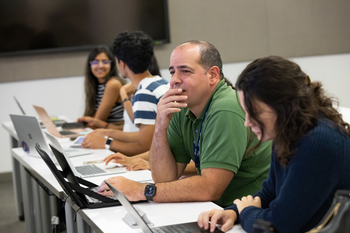
Each week, new material is introduced via in-person lecture. A laboratory session immediately follows, providing students with time to work on problem sets/activities with supervision and assistance from course leaders.
All course materials and handouts will be posted on the course's online syllabus.
Learners will need to request access to several resources 2 weeks prior to the course in preparation for the course, including the UCSF Research Analysis Environment (RAE), the UCSF de-identified Clinical Data Warehouse, UCSF Versa, and possibly MIMIC IV. Instructions on how to do so will be sent out prior to the start of the course.
The online syllabus is made available to enrolled students close to the start of the course.
There will be 2 mini-class projects, one for each major segment of the course (traditional ML/AI and generative AI). Each is expected to take you around 15-20 hours to complete. Assignments will be submitted to the course directors for review.
Students are not expected to have any Python experience prior to this course, and all code can be easily generated through ChatGPT and other LLMs.
Only UCSF students (defined as individuals enrolled in UCSF degree or certificate programs) will receive academic credit for courses. Official transcripts are available to UCSF students only. A Certificate of Course Completion will be available upon request to individuals who are not UCSF students and who satisfactorily pass all course requirements.
For UC-Affiliated learners, the course fee is $2,100
For Non-UC-Affiliated learners, the course fee is $2,500
UC-Affiliation: Concurrent enrollment in a University of California-sponsored residency or post-doctoral fellowship program that is recognized by the Office of Graduate Medical Education; or a registered student in one of the professional schools or graduate programs at the University of California (in a program other than the TICR program); or individuals who hold full-time salaried University of California faculty, academic or staff positions. Please note: Individuals will be asked to provide proof of UC status.
At the end of the course, learners will be able to:
None
Each week, new material is introduced via in-person lecture. A laboratory session immediately follows, providing students with time to work on problem sets/activities with supervision and assistance from course leaders.
All course materials and handouts will be posted on the course's online syllabus.
Learners will need to request access to several resources 2 weeks prior to the course in preparation for the course, including the UCSF Research Analysis Environment (RAE), the UCSF de-identified Clinical Data Warehouse, UCSF Versa, and possibly MIMIC IV. Instructions on how to do so will be sent out prior to the start of the course.
The online syllabus is made available to enrolled students close to the start of the course.
There will be 2 mini-class projects, one for each major segment of the course (traditional ML/AI and generative AI). Each is expected to take you around 15-20 hours to complete. Assignments will be submitted to the course directors for review.
Students are not expected to have any Python experience prior to this course, and all code can be easily generated through ChatGPT and other LLMs.
Only UCSF students (defined as individuals enrolled in UCSF degree or certificate programs) will receive academic credit for courses. Official transcripts are available to UCSF students only. A Certificate of Course Completion will be available upon request to individuals who are not UCSF students and who satisfactorily pass all course requirements.
For UC-Affiliated learners, the course fee is $2,100
For Non-UC-Affiliated learners, the course fee is $2,500
UC-Affiliation: Concurrent enrollment in a University of California-sponsored residency or post-doctoral fellowship program that is recognized by the Office of Graduate Medical Education; or a registered student in one of the professional schools or graduate programs at the University of California (in a program other than the TICR program); or individuals who hold full-time salaried University of California faculty, academic or staff positions. Please note: Individuals will be asked to provide proof of UC status.
Whether you're exploring the field, enhancing your skills, or working toward a larger academic goal, most individual courses are open to everyone. You’ll find details on course fees, how to apply and pay, and the full course schedule. Be sure you understand the payment process before applying.
And remember: you only need to submit one application for all the courses you want to take per quarter.
ATCR and MAS students use the Student Portal
Only one application needs to be completed for all courses desired during the quarter.
Whether you're exploring the field, enhancing your skills, or working toward a larger academic goal, most individual courses are open to everyone. Current learners enrolled in DEB Education programs have priority in enrollment for this course. Any extra spaces are available to non-DEB Education learners (i.e., those from the Institute for Global Health Sciences, School of Nursing, external groups, etc).
You’ll find details on course fees, how to apply and pay, and the full course schedule on the Course Enrollment & Payment page. Be sure you understand the enrollment policies and payment process before completing the enrollment form.
And remember: you only need to submit one form for all the new courses you want to take.