
PhD students are required to spend six quarters in residence and generally to take 8-12 units per quarter. Applicants can take advantage of UCSF’s strengths in biomedical and clinical research as part of our transdisciplinary approach to training and research.
Requirements At A Glance
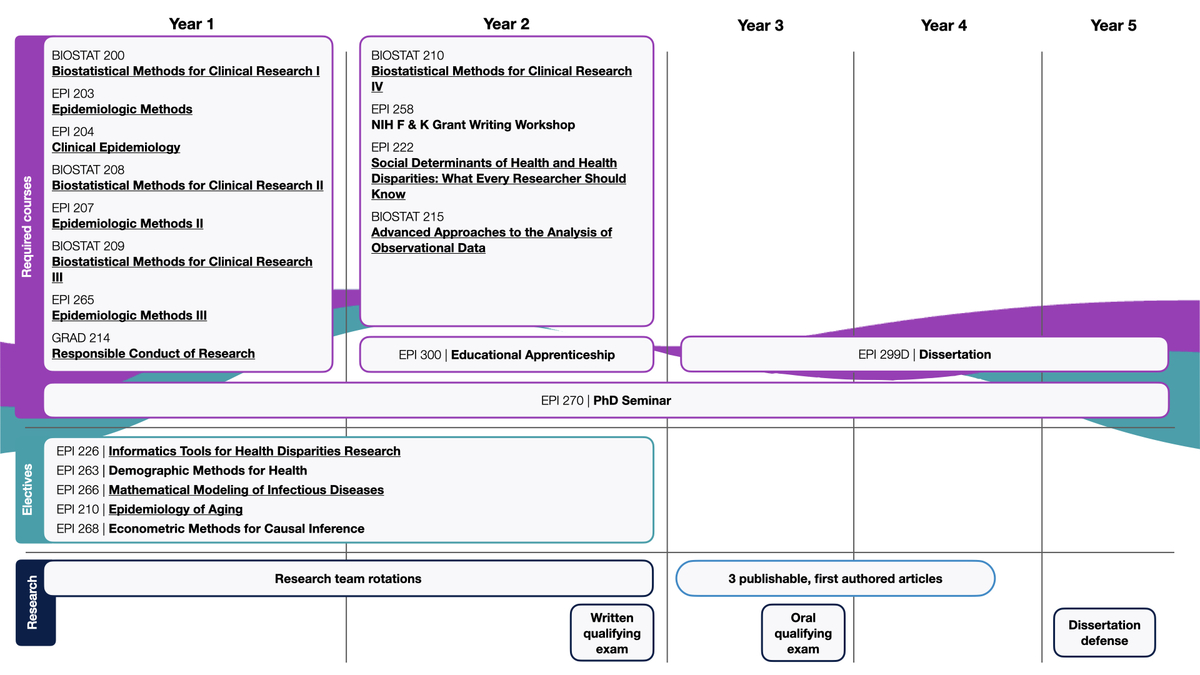
Year 1
BIOSTAT 200 | Biostatistical Methods for Clinical Research I | 3 units
EPI 203 | Epidemiologic Methods | 4 units
EPI 204 | Clinical Epidemiology | 3 units
EPI 270 | PhD Seminar | 2 units
GRAD 214 | Responsible Conduct of Research | 0 units
BIOSTAT 208 | Biostatistical Methods for Clinical Research II | 3 units
EPI 207 | Epidemiologic Methods II | 3 units
EPI 270 | PhD Seminar | 2 units
GRAD 214 | Responsible Conduct of Research | 0 units
Elective Course
BIOSTAT 209 | Biostatistical Methods for Clinical Research III | 3 units
EPI 265 | Epidemiologic Methods III | 3 units
EPI 270 | PhD Seminar | 2 units
GRAD 214 | Responsible Conduct of Research | 1.5 units
Year 2
BIOSTAT 210 | Biostatistical Methods for Clinical Research IV | 2 units
EPI 270 | PhD Seminar | 1 unit
EPI 297 | Research Team Rotation | 4 units
EPI 300 | Educational Apprenticeship | 2 units
- Educational Apprenticeship may be in any quarter during Year 2
EPI 258 | NIH F & K Grant Writing Workshop | 3 units
EPI 222 | Social Determinants of Health and Health Disparities: What Every Researcher Should Know | 2 units
EPI 270 | PhD Seminar | 1 unit
Elective Course
BIOSTAT 215 | Advanced Approaches to the Analysis of Observational Data | 3 units
EPI 270 | PhD Seminar | 1 unit
EPI 297 | Research Team Rotation | 4 units
- Research Team Rotations may be in any quarter through Year 2, and prior to advancing to candidacy
Year 3 & 4
EPI 299D | Dissertation | 8 units
EPI 270 | PhD Seminar | 1 unit
EPI 299D | Dissertation | 8 units
EPI 270 | PhD Seminar | 1 unit
EPI 299D | Dissertation | 8 units
EPI 270 | PhD Seminar | 1 unit